When a civil engineering joint venture or heavy infrastructure firm wins a multi-million-euro public tender, the clock starts ticking instantly. Under EU public procurement rules (Directives 2014/24/EU and 2014/25/EU), contracting authorities impose strict delivery milestones backed by heavy financial penalties for delay.
For heavy equipment dealers, machinery rental fleets and raw material suppliers, contract award notices published on regional and EU portals are high-intent procurement signals. Newly awarded civil contractors face immediate fleet bottlenecks, stringent ESG emissions targets and complex local supply chain constraints.
This localised guide details how to leverage tender data, map machinery and material demand, and position your supply chain capabilities to win high-margin subcontracts across the EU.
Step 1 — Track European award data beyond the general notice
To target civil construction winners, track contract awards at both national and pan-European level within 24–72 hours of publication.
- EU-wide monitoring (above thresholds): track Tenders Electronic Daily (TED) using CPV code 45000000-7 (construction work). Watch high-value infrastructure packages — bridges, highway extensions, rail corridors — above the €5,382,000 public works threshold.
- National & regional portals (below thresholds): monitor local platforms such as BOAMP/PLACE (France), Vergabe.de (Germany) or Contract Finder (UK) for regional earthworks and civil prep tenders.
- Extract critical eForm data points: the winning prime contractor and JV consortium partners, the NUTS code defining the exact site location, and the specified project duration and execution milestones.
Step 2 — Map equipment & material needs to project phasing
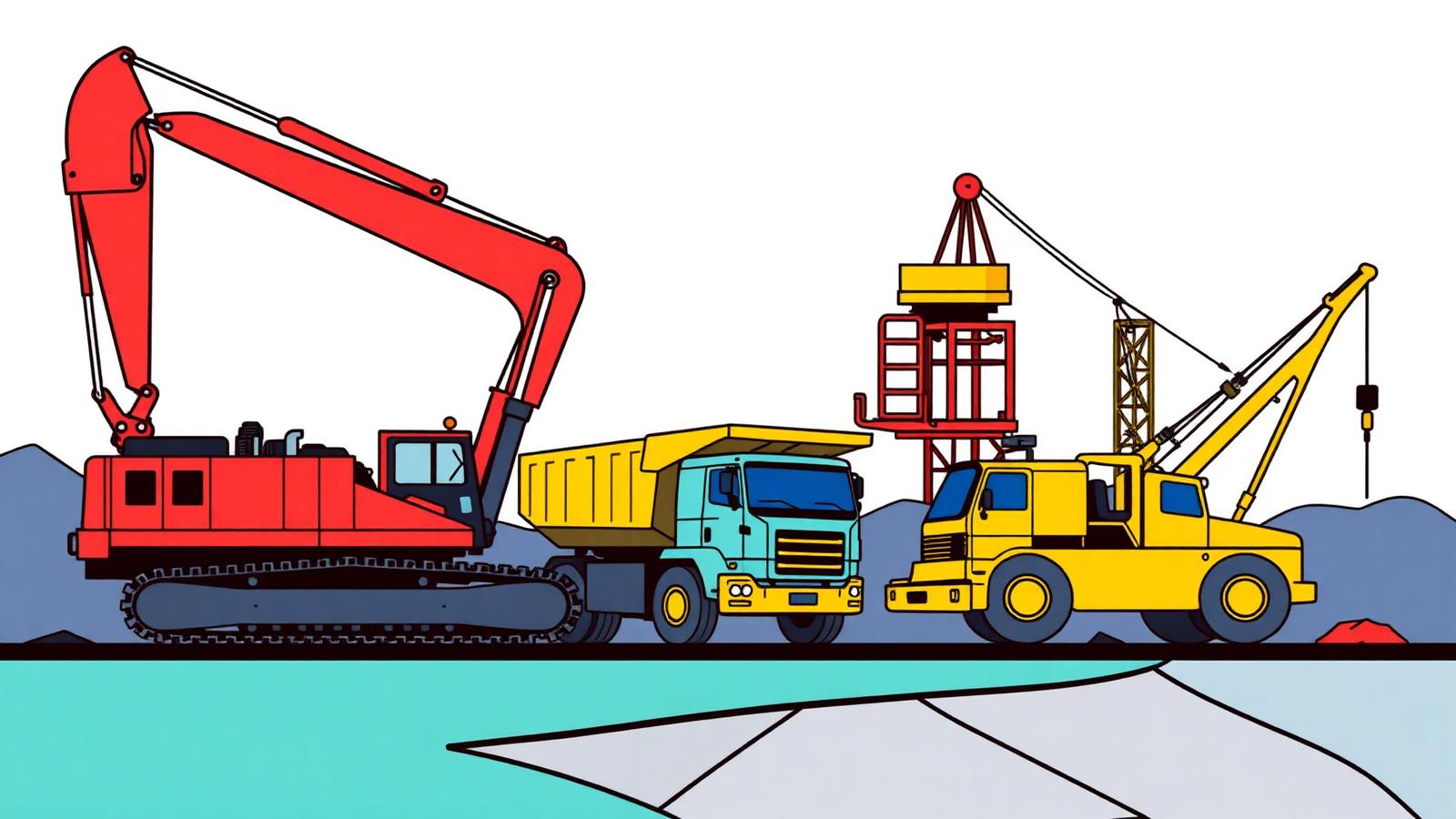
Civil engineering contractors rarely own 100% of the machinery a massive infrastructure project requires. They balance capital expenditure through heavy equipment leasing, localised material sourcing and specialised subcontracting — so demand arrives in waves.
| Project phase | Timeline | Equipment demand | Material & service demand |
|---|---|---|---|
| Phase 1: Earthmoving & site prep | Months 1–3 post-award | Heavy excavators (30t–50t), articulated dump trucks, bulldozers, soil compactors. | Aggregates, geotextiles, site fencing, temporary haul road materials. |
| Phase 2: Structural & civil works | Months 3–12 post-award | Tower cranes, mobile cranes, concrete pumps, piling rigs. | Ready-mix concrete, rebar and structural steel, precast concrete elements. |
| Phase 3: Surface & finishing | Final 25% of timeline | Asphalt pavers, tandem rollers, cold planers, specialised utility rigs. | Bitumen, road marking materials, safety barriers, drainage systems. |
Step 3 — Align with EU compliance & ESG specifications
When pitching a prime contractor executing an EU-funded project (for example under NextGenerationEU infrastructure grants), standard equipment and materials are insufficient. Your offer must support the prime's compliance obligations.
- Stage V emissions standards: many metropolitan low emission zones legally mandate non-road mobile machinery (NRMM) to meet EU Stage V rules. Lead with compliant, low-emission or electric/hybrid machinery.
- Circular economy & recycled content: public tenders score environmental criteria. Supply EPDs (Environmental Product Declarations), locally sourced aggregates or high recycled-content concrete mixes.
- Supply chain due diligence: demonstrate compliance with national supply chain laws such as Germany's LkSG or the EU's CSDDD, with transparent tier-N sourcing for raw materials.

Step 4 — Time outreach around the mobilization gap
Between the Contract Award Notice (CAN) publication and site break-ground, prime contractors enter a 30- to 60-day mobilization phase. This is your outreach window.
Days 1–14
Standstill & internal fleet audit
The winning consortium assesses internal fleet availability against delivery schedules to identify machinery deficits and logistics constraints.
Days 15–45
Mobilization window — primary pitch zone
Equipment managers, procurement officers and site directors issue RFQs for long-term machinery rentals, local aggregate supply and haulage support.
Days 46+
Site logistics lock-in
Primary suppliers are locked into site-level service agreements. Secondary suppliers only get called in as emergency replacements.
Step 5 — Execute high-context outbound pitching
Generic cold calls fail with civil construction executives. Your outreach must prove local supply capability, rapid delivery velocity and operational reliability.
Pitch template — heavy equipment rental & fleet supply
Subject: Fleet allocation for [Project Name / NUTS Region] – [Your Company]
Hi [Name],
Congratulations on winning the [Project Name] contract award in [Region/City].
With site mobilization approaching for the initial earthworks phase, securing Stage V-compliant [e.g. 40t excavators / heavy haulers] within local delivery proximity is critical to maintaining your site schedule.
We operate a fleet depot [X km] from your project site, offering guaranteed 24-hour maintenance turnaround and full EPD documentation for public authority compliance.
Are you open to a brief call this week with your fleet & logistics team to review local equipment availability and volume terms for this contract?
Best regards,
[Your Name]
Pitch template — construction materials & logistics
Subject: Local aggregate & material supply for [Contract Reference]
Hi [Name],
Reaching out regarding [Winning Contractor]'s recent tender win for [Project Name].
Given the project's strict delivery timelines and regional environmental quotas, we can support your supply chain with [e.g. low-carbon concrete / certified structural backfill] directly from our facility in [Local Area].
Why contractors partner with us on public civil works:
— Proximity: delivery lead-times under [X] hours to the site corridor.
— Compliance: full EPD and ISO certifications matching [Contracting Body] requirements.
Can I send over our technical spec sheet and pricing schedule for your procurement team?
Best regards,
[Your Name]
- Lead with the NUTS region: distance to site is the first filter an equipment manager applies — put it in the subject line.
- Quantify turnaround: maintenance SLA, delivery lead-time and machine availability beat brochure specifications.
- Attach compliance up front: EPDs, Stage V certificates and ISO documentation remove a procurement approval step.
Track award notices automatically
TenderMaze monitors EU contract award notices daily, scores winners against what you sell, and alerts you inside the golden window.
Start prospecting